
How to Start Accepting Card Payments in the UK: 2026 Merchant Guide
23 September 2026 · 14 min read

You shouldn't have to sign an expensive three-year lease or decipher confusing financial jargon just to take a customer's card. If you are exploring how to start accepting card payments UK providers often bury you under complex talk of acquiring banks, interchange fees, and terminal rental overheads. Worse still, many traditional systems hold your money for days before it reaches your bank account. You simply need a reliable way to take sales, protect your daily cash flow, and serve customers without friction.
The good news is that payment processing has changed. Modern card acceptance requires no monthly terminal hire, no restrictive lock-in contracts, and no settlement delays. In this guide, you will get a clear, step-by-step roadmap to setting up seamless, low-cost card payments for your business. We will walk you through choosing reliable hardware without rental fees, securing transparent processing rates, and getting your funds delivered the very next day.
Key Takeaways
- Learn how card transactions move from tap to settlement without drowning in confusing banking jargon.
- Identify the right terminal setup for your specific trading space, prioritising dual Wi-Fi and 4G roaming connectivity.
- Avoid predatory 36-month terminal leases and decode complex interchange and processing fees before signing any agreement.
- Follow a practical five-step checklist on how to start accepting card payments UK merchants can implement immediately.
- Protect your daily cash flow by securing zero monthly terminal rentals and reliable next-day payouts.
Understanding How Card Payments Work for UK Businesses
A merchant account is a dedicated commercial bank account that temporarily holds customer card funds while they are authorised and cleared before being transferred to your regular business bank account.
Running a cash-only operation quietly caps your revenue. With debit cards dominating daily spending and contactless taps accounting for the vast majority of in-person purchases, turning away cardholders means losing valuable sales to competitors. Knowing what happens behind the screen is the first step when researching how to start accepting card payments UK wide. The process isn't mysterious; it's a secure digital relay between banking networks.
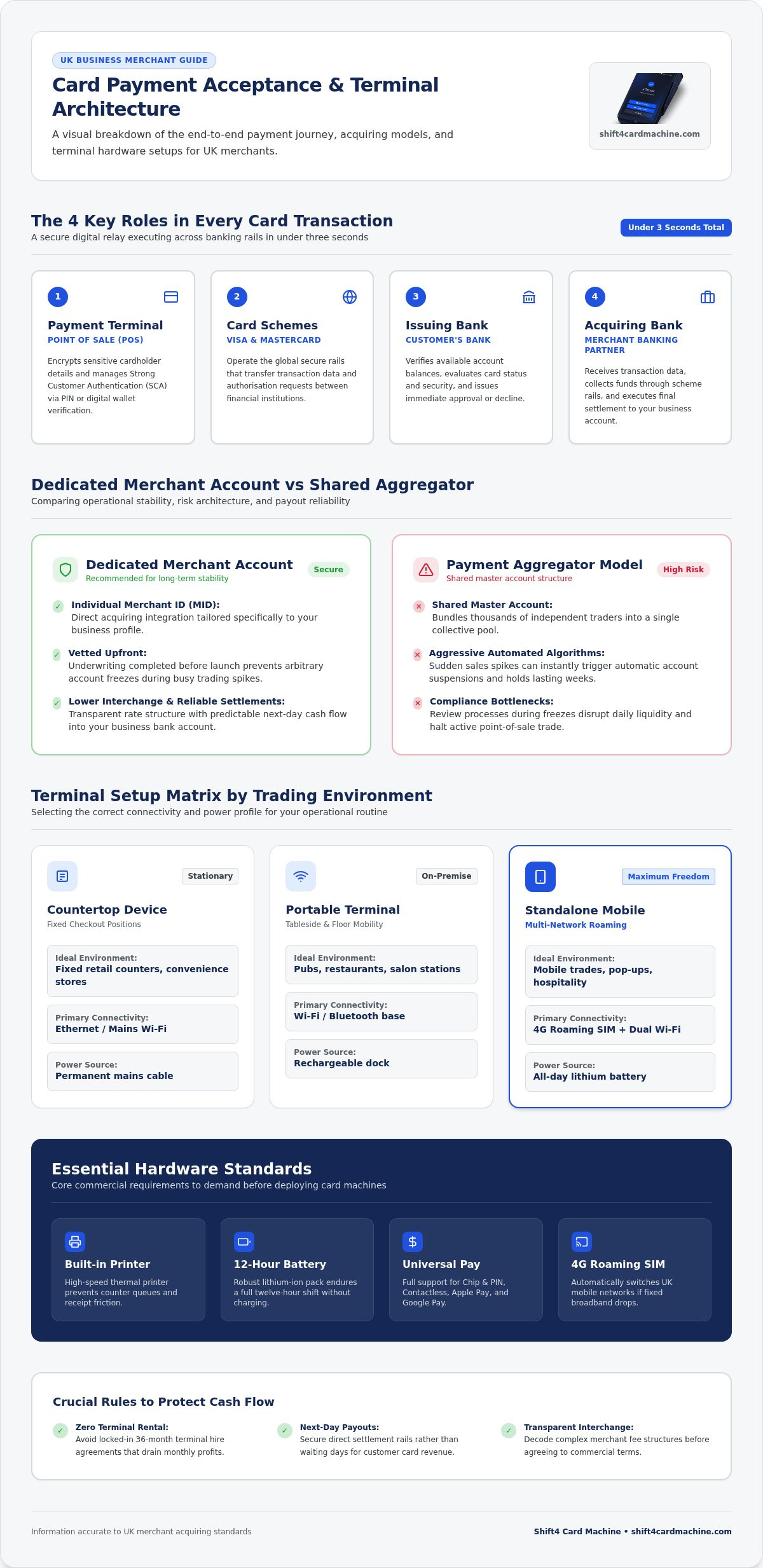
The Four Key Roles in Every Transaction
Every card sale relies on four distinct entities communicating in under three seconds:
- The Issuing Bank: Your customer's bank. It verifies available balances, checks card status, and approves or declines the charge.
- The Card Schemes: Global networks like Visa and Mastercard that operate the secure rails transferring data between institutions.
- The Acquiring Bank: Your merchant banking partner. It receives the transaction, collects the funds from the scheme, and handles settlement.
- The Payment Terminal: A certified payment terminal encrypts sensitive cardholder details at the point of sale, managing Strong Customer Authentication (SCA) via PIN or digital wallet verification before sending data upstream.
Dedicated Merchant Accounts vs Aggregator Models
Payment aggregators bundle thousands of independent traders into a single shared master account. While initial onboarding is quick, aggregators rely on aggressive automated risk algorithms. An unexpected spike in Saturday trade can trigger automatic account freezes, holding your money for weeks while compliance teams review your paperwork.
Dedicated merchant accounts work differently. You receive an individual merchant ID backed by direct acquiring integration. Because your business is vetted upfront, you gain rock-solid processing stability, lower interchange rates, and predictable settlements without the threat of arbitrary account suspensions. When evaluating how to start accepting card payments UK business owners achieve far greater long-term security by choosing dedicated acquiring infrastructure.
Choosing the Right Card Machine Setup for Your Business
Card readers have evolved far beyond basic plastic dongles that tether to a personal smartphone via patchy Bluetooth connections. When figuring out how to start accepting card payments UK traders need standalone hardware that operates independently, processes transactions rapidly, and never drops signal mid-sale. Choosing the right device comes down to your physical checkout space and your daily trading environment. Reviewing our breakdown of the best card machines for UK small businesses can help you match device features directly to your operational routine.
Countertop vs Portable vs Standalone 4G Readers
Fixed countertop devices connect via ethernet or power cables, sitting permanently beside a till. They suit high-street retail counters with dedicated cash wraps. Portable terminals utilise local Wi-Fi to move between tables or across a shop floor, returning to a charging base between shifts.
Standalone mobile readers offer complete operational freedom. Fitted with multi-network roaming SIMs, these devices jump between major UK cellular networks automatically. If your fixed broadband cuts out, your sales continue without missing a beat.
| Terminal Type | Ideal Trading Environment | Primary Connectivity | Power Source |
|---|---|---|---|
| Countertop | Fixed retail counters, convenience stores | Ethernet / Mains Wi-Fi | Mains cable |
| Portable | Pubs, restaurants, salon stations | Wi-Fi / Bluetooth base | Rechargeable dock |
| Standalone Mobile | Mobile trades, pop-ups, hospitality | 4G Roaming SIM + Wi-Fi | All-day battery |
Essential Hardware Features to Demand
Reliability matters far more than unnecessary software gimmicks. A commercial terminal should feature a built-in high-speed thermal printer; relying on digital receipts creates unnecessary counter queues and frustrates hurried shoppers. Look for robust lithium-ion battery packs capable of enduring a full twelve-hour trading shift without requiring emergency top-ups.
Universal support for chip and PIN, standard contactless taps, Apple Pay, and Google Pay is non-negotiable. As you evaluate device options alongside baseline credit card processing fees, steer clear of outdated button-only accessories. To modernise your counter without accumulating fixed overheads, you can set up a dedicated Shift4 card machine that delivers complete standalone mobility without costly monthly hardware rental charges.
Deciphering Merchant Fees, Hidden Costs, and Payout Schedules
Headline rates rarely tell the whole story. A supplier might advertise attractive low percentages, but your monthly statement soon balloons with statement fees, gateway charges, and administrative surcharges. When researching how to accept credit card payments, understanding how providers build their pricing keeps you from surrendering hard-earned trading margin.
Flat-Rate vs Interchange-Plus Pricing Structures
Every transaction cost splits into three parts: the interchange fee paid to the customer's bank, scheme fees collected by Visa or Mastercard, and the acquiring margin. In the UK, interchange fees on consumer debit and credit cards are capped by regulation at 0.2% and 0.3% respectively.
Aggregators often bundle these into a single flat rate, typically between 1.5% and 2.5%. That suits side hustles processing occasional small sums. But as your trading volume expands, paying flat rates means surrendering hundreds of pounds in unnecessary margin. A low, predictable processing rate backed by direct acquiring delivers immense savings month after month.
Avoiding Unfair Leases and Ancillary Charges
Watch out for the classic high-street bank trap: non-cancellable equipment leases. Many legacy providers lock businesses into rigid 36-month or 48-month terminal hire agreements managed by third-party finance companies. You end up paying thousands of pounds to rent hardware worth a fraction of that figure.
Beyond terminal hire, check the fine print for recurring operational deductions:
- Monthly PCI compliance or non-compliance penalties
- Authorisation fees levied on every individual card tap
- Minimum monthly service charges (MMSC) if trade dips
- Paper statement generation fees
To avoid these recurring drains on your balance sheet, explore merchant services UK no monthly fee models that do away with terminal rentals and administrative overheads entirely.
The Cash Flow Impact of Fund Settlement Timing
Taking money is easy; receiving it promptly is what keeps your doors open. Standard high-street acquiring settlements take three to five working days to clear into a merchant account. If you trade heavily over a bank holiday weekend, your takings could sit inaccessible for nearly a week.
That waiting window restricts working capital. It delays restocking shelves, paying suppliers, and covering weekly staff payroll. As you evaluate how to start accepting card payments UK wide, prioritize partners offering next-day settlement. Our detailed card machine next day payout guide explains how rolling daily payouts protect your trading resilience.
Step-by-Step: How to Start Taking Card Payments in the UK
Getting your business ready for card acceptance doesn't require weeks of back-and-forth communication or stacks of physical forms. By following a structured five-step path, you can set up secure acquiring infrastructure and begin processing sales quickly. Here is the operational checklist for how to start accepting card payments UK wide.
Steps 1 & 2: Business Readiness and Paperwork Gathering
Start by setting up a dedicated UK business bank account. Keeping trading income separated from personal funds ensures clean bookkeeping and satisfies mandatory Know Your Customer (KYC) requirements. Next, assemble your compliance paperwork before beginning any application:
- Government-issued photo identification (a valid UK driving licence or passport)
- Proof of trading address dated within three months (such as a utility bill or commercial lease)
- Companies House registration number for limited entities, or HMRC self-assessment details for sole traders
- An estimate of your projected monthly card turnover to secure the most competitive processing tier
Steps 3 & 4: Application, Approval, and Hardware Delivery
Submit your details through an online application portal. Modern merchant acquiring removes the old routine of scheduling high-street bank appointments. Your documentation passes through automated Anti-Money Laundering (AML) checks in minutes rather than days.
Once your account is approved, your card terminal ships directly to your trading premises. Quality providers pre-configure the hardware before dispatch. That means you receive a device already linked to your merchant ID, eliminating complex on-site programming.
Step 5: Testing, Training, and Live Transactions
Unbox the reader, power it up, and connect to Wi-Fi or let the built-in roaming SIM register automatically. Process a 1p test transaction using your own debit card. This quick check confirms that the acquiring gateway authorises transactions and records data properly before you open your doors to the public.
Train your counter team to handle common customer scenarios. Walk them through initiating swift contactless refunds, dealing calmly with cardholder decline prompts, and handling chip read failures by prompting customers to re-insert or tap a digital wallet. Finally, display clear scheme decals by your checkout to let customers know you welcome contactless cards, Apple Pay, and Google Pay.
Streamlining Payments with Shift4 Card Machine Solutions
Traditional banks complicate card processing with endless fees, while app-based aggregators slice into your revenue with high percentages. Shift4 removes that friction entirely. By combining direct merchant acquiring with commercial-grade hardware, UK traders get a streamlined package designed to protect daily profit margins.
Shift4 OneCard Machine: Built for Demanding Environments
The Shift4 OneCard Machine handles the pressure of busy retail counters and fast-moving hospitality environments effortlessly. Featuring an intuitive touchscreen display, an integrated high-speed thermal receipt printer, and an all-day battery, it eliminates the clutter of separate charging cables and external printers. Built-in 4G roaming connectivity ensures that if local Wi-Fi drops, your hardware switches immediately to cellular data. Every terminal includes a lifetime hardware replacement warranty, giving you complete peace of mind that a damaged unit won't halt trading. For a comprehensive review of hardware specifications, read our Shift4 OneCard merchant guide.
Transparent Rates and Next-Day Settlement
Most merchant providers chip away at your turnover with monthly statement charges, compliance costs, and terminal hire fees. Shift4 replaces that complex billing model with clarity:
- Zero monthly terminal rental fees to weigh down quiet trading periods
- A fixed 0.85% processing fee on card transactions
- Next-day payouts directly into your UK bank account to keep working capital fluid
- No unexpected authorisation fees or administrative penalties
Switching from aggregator rates near 1.75% to a fixed 0.85% processing fee saves growing businesses hundreds of pounds each month. Combined with guaranteed next-day payouts, your funds land in your account right when you need them to restock stock and settle supplier invoices.
Straightforward National Onboarding
Deciding how to start accepting card payments UK wide shouldn't involve painful bureaucracy. The Shift4 onboarding process is entirely digital, taking you from initial paperwork submission to acquiring approval in record time. Card machines arrive pre-configured and ready to take sales out of the box, with nationwide UK delivery.
Rather than dealing with offshore call centres or automated chat bots, you gain access to direct support from dedicated UK payment specialists who understand domestic retail and hospitality. Ready to cut processing overheads and speed up daily cash flow? It takes just minutes to apply for their card machine with Shift4.
Take Control of Your Business Payments
Setting up smooth card processing shouldn't mean accepting unfair contracts, hidden fees, or frustrating settlement delays. When evaluating how to start accepting card payments UK business owners deserve transparent pricing, dependable hardware, and rapid access to their daily earnings.
You can ditch expensive equipment leases for good. Shift4 gives you zero monthly terminal rental fees, a transparent 0.85% transaction fee on debit and credit cards, and next-day payouts to protect your working capital. Every terminal comes protected by a lifetime hardware warranty with dedicated UK-wide support, ensuring your counter never grinds to a halt.
Equip your business with the modern tools needed to thrive. Give your customers the effortless checkout experience they expect whilst keeping your hard-earned trading profits right where they belong.
Frequently Asked Questions
Can I start accepting card payments in the UK as a sole trader?
Yes, sole traders can accept card payments just as easily as limited companies. You don't need to be registered with Companies House to open a merchant facility. When figuring out how to start accepting card payments UK sole traders simply provide their National Insurance number, HMRC registration details, valid photo identification, and proof of a dedicated business bank account to clear compliance quickly.
Do I need a separate merchant account to take card payments?
Yes, but you don't need to source one independently from a high-street bank. Modern payment solutions bundle merchant account integration directly with the terminal. This dedicated acquiring setup routes customer card transactions through scheme clearing rails securely. It prevents the random account freezes common with shared aggregator platforms whilst ensuring seamless settlement into your regular business bank account.
How much does a card machine cost to rent or buy in the UK?
Traditional providers typically charge £15 to £30 per month to hire a terminal on restrictive 36-month contracts, while basic plug-in card readers can cost £19 to £29 upfront. However, you don't need to pay either. Shift4 provides the Shift4 OneCard Machine with zero monthly rental fees and no upfront purchase cost, relying entirely on a transparent 0.85% processing rate.
What documents do I need to supply to get approved for a card machine?
UK merchant approval requires proof of identity, proof of address, and verified banking details. You will need a valid UK passport or photocard driving licence, a utility bill or bank statement dated within the past three months, and your business bank account details. Limited companies must provide their Companies House registration number, while sole traders provide HMRC self-assessment details.
How quickly do funds from card payments land in my UK bank account?
Payout speeds depend entirely on your payment provider, ranging from several business days down to twenty-four hours. Standard high-street acquirers take three to five working days to clear balances. Modern merchant solutions like Shift4 deliver next-day payouts directly to your UK bank account. That rapid turnaround keeps your working capital liquid so you can pay suppliers and replenish stock without delay.
Can my business accept contactless payments over the standard limit?
Yes, customers can exceed the standard contactless threshold by paying with mobile wallets such as Apple Pay or Google Pay. While physical card taps generally stick to the £100 cap set by issuing banks, digital wallets use biometric authentication on the customer's phone. This satisfies Strong Customer Authentication requirements, allowing shoppers to complete contactless transactions of virtually any amount safely.
What happens if my card payment machine loses Wi-Fi connection during service?
Your card machine will automatically switch over to cellular data if it includes hybrid connectivity. When considering how to start accepting card payments UK business owners should ensure their hardware contains an integrated multi-network 4G roaming SIM. If your local broadband fails, the terminal instantly connects to the strongest available mobile network, allowing you to process sales without interruption.
Frequently Asked Questions
Yes, sole traders can accept card payments just as easily as limited companies. You don't need to be registered with Companies House to open a merchant facility. When figuring out how to start accepting card payments UK sole traders simply provide their National Insurance number, HMRC registration details, valid photo identification, and proof of a dedicated business bank account to clear compliance quickly.
Yes, but you don't need to source one independently from a high-street bank. Modern payment solutions bundle merchant account integration directly with the terminal. This dedicated acquiring setup routes customer card transactions through scheme clearing rails securely. It prevents the random account freezes common with shared aggregator platforms whilst ensuring seamless settlement into your regular business bank account.
Traditional providers typically charge £15 to £30 per month to hire a terminal on restrictive 36-month contracts, while basic plug-in card readers can cost £19 to £29 upfront. However, you don't need to pay either. Shift4 provides the Shift4 OneCard Machine with zero monthly rental fees and no upfront purchase cost, relying entirely on a transparent 0.85% processing rate.
UK merchant approval requires proof of identity, proof of address, and verified banking details. You will need a valid UK passport or photocard driving licence, a utility bill or bank statement dated within the past three months, and your business bank account details. Limited companies must provide their Companies House registration number, while sole traders provide HMRC self-assessment details.
Payout speeds depend entirely on your payment provider, ranging from several business days down to twenty-four hours. Standard high-street acquirers take three to five working days to clear balances. Modern merchant solutions like Shift4 deliver next-day payouts directly to your UK bank account. That rapid turnaround keeps your working capital liquid so you can pay suppliers and replenish stock without delay.
Yes, customers can exceed the standard contactless threshold by paying with mobile wallets such as Apple Pay or Google Pay. While physical card taps generally stick to the £100 cap set by issuing banks, digital wallets use biometric authentication on the customer's phone. This satisfies Strong Customer Authentication requirements, allowing shoppers to complete contactless transactions of virtually any amount safely.
Your card machine will automatically switch over to cellular data if it includes hybrid connectivity. When considering how to start accepting card payments UK business owners should ensure their hardware contains an integrated multi-network 4G roaming SIM. If your local broadband fails, the terminal instantly connects to the strongest available mobile network, allowing you to process sales without interruption.
Related articles
Ready for your free machine?
No rental. No catch. Apply in 2 minutes.