
Is my business ready to accept card payments? A 2026 UK checklist
26 September 2026 · 16 min read

Accepting card payments isn’t just a hardware decision. It shapes the customer journey, from how people pay to when the money reaches your account. If you’re asking, “is my business ready to accept card payments?”, the answer depends on more than choosing a card machine.
Before committing, consider fees, payout timing, connectivity and staff preparation. The right setup for a shop may not suit a mobile service or a business that mainly sells online.
This checklist will help you assess customer demand, day-to-day operations and payment needs. It covers equipment, connectivity, staff confidence, payment security and the terms to check with a provider. By the end, you should have a clearer view of what’s ready, what needs attention and what to ask before choosing a service.
Key Takeaways
- To answer “is my business ready to accept card payments?”, look at where customers buy, how they prefer to pay and where payment issues create friction.
- Prepare your business details and check the provider’s current application requirements before choosing a payment method or equipment.
- Compare transaction charges, recurring fees, payout timing, contract terms and support together. Don’t judge a provider by one headline rate.
- Before launch, check terminal access, connectivity, staff responsibilities and customer communication. Practise the payment and refund process using your provider’s instructions.
- Confirm the terms that matter to your business, including payout conditions, hardware cover and any recurring fees.
Is my business ready to accept card payments? Start with customer demand
Start with what happens when customers try to pay. Readiness depends on more than interest in card payments. You’ll also need a process your staff can manage, a payment setup suited to your sales and provider terms you understand.
Review recent sales and customer interactions. How do people pay now? Where do sales happen: at a counter, during appointments, on delivery or remotely? Do cash-only steps cause delays, awkward handovers or purchases customers don’t complete? Your own observations are more useful than assumptions about what customers prefer.
Business readiness means meeting customers’ payment needs with a setup your team can operate and provider terms your business understands. Customer interest is a useful signal, but it isn’t the whole decision. Weigh demand against staff workflows, equipment, connectivity, charges and payout arrangements.
What signs suggest customers want to pay by card?
Look for direct requests, repeated delays whilst customers find cash, or abandoned purchases when someone discovers you can’t accept their preferred payment method. Note where these issues occur. A shop may see friction at the till; an appointment-based business may encounter it when payment is due after a service. For remote transactions, consider whether your current process makes it easy to complete an order.
Expectations differ by setting, so review your own sales rather than relying on general claims. Keep a simple record of payment requests and points where a sale slows down. If you want a basic overview of different types of payment cards, it can help clarify the options customers may ask about.
Which businesses may benefit from accepting card payments?
A retailer might assess card payments if cash handling interrupts service at busy times. A café or restaurant could consider whether customers need a convenient way to pay at the end of a visit. A hair or beauty business may find that cash-only payments after appointments add friction. These are prompts for assessing your needs, not guarantees that card payments suit every business.
Consider transaction size, how often you make sales and where customers pay. Frequent, lower-value purchases may make speed at the point of sale a priority. Less frequent or higher-value transactions may put more weight on provider charges and payout arrangements. A mobile business should consider connectivity, whilst remote sales call for a payment process suited to that setting. For a closer look at equipment options, explore this guide to card machines for UK small businesses. Use it alongside your own sales patterns, not instead of them.
What needs to be in place before your business accepts card payments?
Before you apply, work through the practical details. A terminal is only one part of the setup. You’ll also need to choose how customers will pay, understand the provider’s terms and decide how payments fit into your team’s daily routine.
A card terminal captures an in-person payment. Payment processing moves the transaction through the payment system, whilst merchant account integration connects that process to your business’s account. Ask the provider how these parts work together in its setup.
Your pre-launch checklist
- Prepare your business details. Check that your business and ownership information is accurate, and decide which account should receive settlements.
- Check the application process. Ask what information, supporting documents and checks the provider requires. Requirements vary, so follow its current instructions rather than assuming one document list applies to every business.
- Choose your payment method. Match each sales channel to a suitable way to accept payment, such as in person, online, by phone or on the move. For phone transactions, ask which methods the provider supports and recommends.
- Confirm the equipment and setup. Consider where a terminal will be used and what connectivity is available there. A card machine may suit face-to-face sales, but it may not cover every channel your business uses.
- Agree the staff process. Decide who will take payments, what to do if a transaction doesn’t work and how staff should follow the provider’s instructions.
Choose equipment for the way you sell
Match the setup to your actual sales channels. A counter-based business may need a terminal within easy reach, whilst mobile sales call for equipment and connectivity suited to the places you work. Online or remote sales may require a different payment method, so check whether the provider’s service supports those transactions before applying.
If you’re considering a terminal, the Shift4 OneCard guide is one place to review information about that machine. Compare its details with your needs rather than assuming a terminal is right for every payment situation.
Ask providers how their setup handles payment security and which steps apply to your business. The Payment Card Industry Data Security Standard (PCI DSS) resource explains the standard. Confirm your specific responsibilities with your provider and check current guidance. If you’re weighing a machine alongside merchant account integration, you can also review Shift4’s card payment offering and confirm its terms directly.
How to assess card-payment providers without overlooking the trade-offs
Once you know how you want to take payments, compare providers against the way your business trades. A low transaction charge may look appealing, but it doesn’t tell you whether there are recurring fees, a minimum term or payout conditions that affect cash flow.
The best fit is the provider whose full service terms suit your business, not simply the one with the most attractive headline feature. Ask each provider the same questions, then check the answers against its current agreement before signing up.
| What to compare | What to check |
|---|---|
| Transaction charges | How charges apply to the transactions you expect to take, and whether exclusions or different rates apply. |
| Recurring fees | Any ongoing service charges, including whether equipment rental is separate from processing charges. |
| Settlement timing | The stated payout schedule, cut-off times, weekend arrangements and exceptions. |
| Contract terms | Minimum term, renewal arrangements and any conditions or charges for ending the agreement. |
| Support and equipment | When support is available, what hardware cover includes and what to do if equipment stops working. |
Which costs and contract details should you check?
Separate the costs clearly. Equipment rental is not the same as a charge for processing each transaction, and other service charges may apply. Ask the provider to explain each cost, when it applies and whether conditions or exclusions affect it. Check the agreement for minimum terms and exit conditions, not just the summary or sales conversation.
If a provider describes a terminal as having no monthly rental fee, confirm the eligibility and applicable terms directly. For a closer look at what to investigate, read this UK guide to merchant services without monthly fees. It’s a useful comparison topic, not a substitute for reviewing your own offer.
Will payout timing, support and equipment suit your workflow?
Ask when funds are expected to reach your account and whether cut-off times, weekends or other exceptions affect the schedule. Don’t assume “next-day” means the same thing across providers. Shift4 offers next-day payouts, but confirm the timing, eligibility and conditions that apply to your arrangement.
Check how to get help, what happens if a terminal stops working and exactly what any hardware warranty covers or excludes. Shift4 offers a lifetime hardware warranty, but confirm its coverage and exclusions in the terms. Compare these practical details alongside charges and contract conditions. That broader view can help you answer “is my business ready to accept card payments?” with fewer surprises.
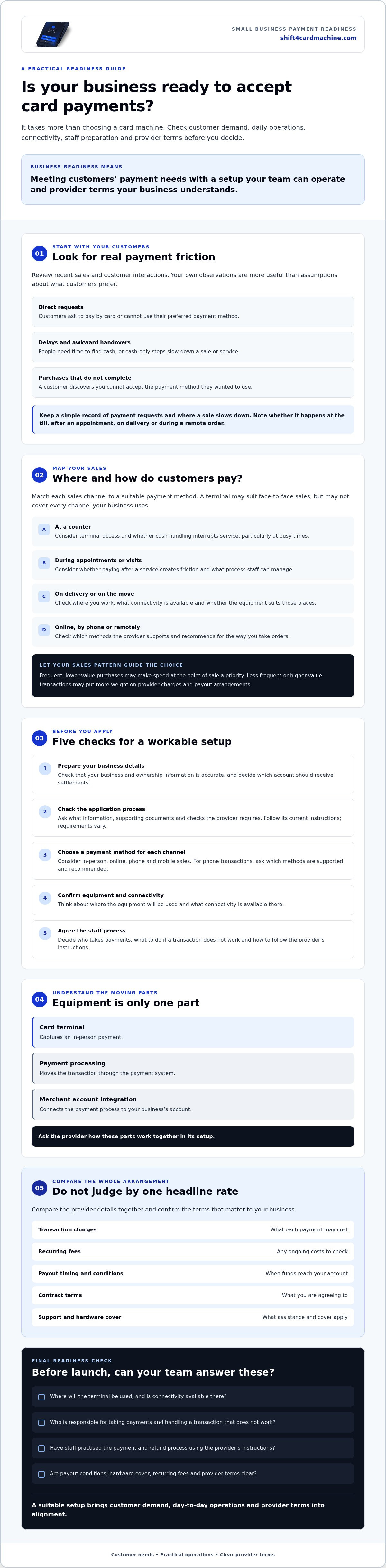
Use this practical checklist to prepare your staff and payment setup
A payment setup is ready only when it works where you trade and your team knows what to do. Before the first customer taps or inserts a card, check the everyday details. Keep operational preparation separate from compliance: practise how the process works, then confirm security responsibilities using current provider guidance and relevant UK standards.
Before-launch checklist
- Terminal access: Put the machine where staff can reach it easily and customers can use it comfortably. Make sure the relevant team members know how to access and set it up.
- Connectivity: Check the connection in the exact spot where payments will happen. If you trade in more than one place, consider whether the setup suits each location.
- Staff roles: Agree who sets up the terminal, answers basic payment questions, handles receipts and contacts the provider if something goes wrong.
- Customer communication: Tell customers which payment methods you accept. Update signs or checkout information so they know before they reach the payment stage.
- Test process: Follow the provider’s instructions to test an appropriate transaction, issue a receipt and practise the refund workflow. Use its approved process rather than experimenting with a live customer payment.
Can staff take payments confidently and securely?
Training can be straightforward. Staff should know the normal steps, what to do if a payment is declined and where to direct questions they can’t answer. Make sure they understand how to handle payment information carefully and follow the provider’s security guidance.
Keep compliance questions distinct from routine training. The Payment Card Industry Data Security Standard (PCI DSS) sets out security standards for payment card data, but the steps relevant to your business depend on your arrangements. Check current PCI DSS information and ask your provider to explain your responsibilities. Don’t assume that using a terminal alone settles every security question.
Have you tested the customer payment journey?
Walk through the process as a customer would: reaching the payment point, completing a transaction and receiving a receipt. Then check how a refund should be handled. Confirm the connection is suitable where the terminal will be used, and make accepted payment methods clear at the till, reception desk or booking point.
Picture a busy trading period. One staff member is serving the next customer whilst another takes payment. If the terminal is out of reach, the connection is unreliable or nobody knows who handles a failed transaction, a small snag can slow the handover. Rehearsing the process helps your team spot gaps before customers are waiting. It can’t guarantee uninterrupted service, but it gives staff a clear routine to follow.
Ready to accept card payments? Choose a simple next step
You don’t need to make a decision today. If customer demand is clear, your team understands the process and you’ve found terms that suit your business, you may be ready to apply. If key details are unclear, gather answers first. If card payments don’t solve a current problem, revisit the checklist when your sales or customer needs change.
Before proceeding, confirm these points directly with each provider:
- Eligibility and charges: Ask whether your business qualifies and request a clear explanation of transaction charges, recurring fees and any exclusions.
- Payouts and contract: Confirm settlement timing, conditions and exceptions, alongside the agreement’s term and exit conditions.
- Setup and support: Find out how merchant account integration works, what terminal support includes and how to contact the provider if equipment needs attention.
- Hardware cover: Ask what the warranty covers and excludes, and keep the written terms with your payment records.
Keep copies of the agreement and provider guidance where the people responsible for payments can find them. Clear records make it easier to answer staff questions and check the agreed process later.
Make the first payment straightforward
Once you’ve chosen a provider, name the person responsible for setting up the equipment and make sure staff know where to direct questions. Put clear payment instructions where customers make their decision, such as at checkout or when confirming an appointment. Before accepting a live payment, practise the operating steps using the provider’s instructions.
A practical route is to shortlist providers, confirm their current terms, complete the application, prepare the team and test the setup. Shift4 Card Machine is one UK-wide option to assess. Its offering includes the Shift4 OneCard Machine, merchant account integration, next-day payouts and a lifetime hardware warranty. Shift4 Card Machine also offers terminals with no monthly rental fee and a 0.85% transaction rate on credit and debit card transactions processed through the provided hardware. Confirm current eligibility, payout conditions, warranty coverage, fees and contract terms before deciding whether it fits.
If the details suit your business, you can explore Shift4 Card Machine. Take the next step when you’re comfortable with the terms and your team is ready.
Take your next step with confidence
If you’re still asking, “is my business ready to accept card payments?”, use the checklist to make a decision that fits your customers and the way your business operates. Customer demand is a useful starting point. A workable staff process and a clear understanding of provider terms matter just as much.
Before applying, compare the full agreement, including charges, payout conditions, contract terms and hardware cover. Then make sure your team knows how to take a payment and where to turn for guidance. You can proceed, gather more information or return to the checklist later. There’s no need to rush a decision.
Shift4 Card Machine is one UK-wide option to consider. Its offering includes next-day payouts and a lifetime hardware warranty. Confirm payout conditions, warranty coverage and exclusions, along with the terms that apply to your business, before deciding whether it’s the right fit.
Frequently Asked Questions
Is my business ready to accept card payments?
You may be ready if customers have a reason to pay by card, you’ve chosen a payment method that suits your sales channels and you understand the provider’s terms. Check that staff can follow the payment process and relevant security guidance. Readiness isn’t determined by business size alone. Consider how often you make sales, where customers pay and whether card acceptance would resolve a real difficulty in your daily workflow.
What does a business need to accept card payments in the UK?
Requirements depend on the provider and how you plan to take payments. You’ll generally need to apply for a suitable payment service, provide the business information the provider requests and arrange the relevant equipment or online setup. Before accepting payments, check charges, payout terms, security guidance and support arrangements. Application checks and document requirements aren’t identical across providers, so follow the instructions for the service you’re considering.
Can a new business accept card payments?
Yes, a new business can explore card acceptance, subject to the provider’s eligibility criteria and application checks. Be ready to explain what your business does and provide the information requested during onboarding. Before choosing a service, consider how its charges, payout schedule and contract terms fit your expected sales and cash flow. Confirm current eligibility directly with the provider before applying, as requirements can vary between services and businesses.
Do I need a card machine to accept card payments?
No, a card machine isn’t necessary for every type of card payment. It’s designed for face-to-face transactions, such as taking payment at a counter or during an appointment. Online or other remote sales may need a different payment setup. If you sell through several channels, ask providers whether their service supports each one and whether separate equipment or arrangements are needed. Choose based on where and how customers pay.
How do I choose a card payment provider for my business?
Compare the full service, not just one headline feature. Check transaction charges, recurring fees, contract and exit terms, payout timing, support, equipment cover and which payment methods are supported. Ask providers to explain how the terms apply to your business, and get unclear points confirmed in writing before you agree. The right fit depends on your sales pattern, customer journey and operating needs, so assess the trade-offs together.
Is it safe for my business to accept card payments?
Card payments can be handled safely when you use an appropriate provider, follow its security instructions and train staff to protect payment information. Your responsibilities depend on how you take payments and which systems are involved. Check the provider’s current guidance and the PCI DSS requirements relevant to your setup. Don’t rely on assumptions about what a terminal or provider handles for you. For specific questions, ask your provider or a qualified adviser.
What should I do before taking my first card payment?
First, confirm that provider onboarding is complete and follow its instructions to set up your terminal or payment service. Make sure staff understand how to take payments, handle refunds and get support if something goes wrong. Test the customer journey using the provider’s approved process, where permitted. Review the agreed charges and payout terms, then make accepted payment methods clear to customers at checkout, when booking or wherever they pay.
Frequently Asked Questions
Look for direct requests, repeated delays whilst customers find cash, or abandoned purchases when someone discovers you can’t accept their preferred payment method. Note where these issues occur. A shop may see friction at the till; an appointment-based business may encounter it when payment is due after a service. For remote transactions, consider whether your current process makes it easy to complete an order. Expectations differ by setting, so review your own sales rather than relying on general claims. Keep a simple record of payment requests and points where a sale slows down. If you want a basic overview of different types of payment cards, it can help clarify the options customers may ask about.
A retailer might assess card payments if cash handling interrupts service at busy times. A café or restaurant could consider whether customers need a convenient way to pay at the end of a visit. A hair or beauty business may find that cash-only payments after appointments add friction. These are prompts for assessing your needs, not guarantees that card payments suit every business. Consider transaction size, how often you make sales and where customers pay. Frequent, lower-value purchases may make speed at the point of sale a priority. Less frequent or higher-value transactions may put more weight on provider charges and payout arrangements. A mobile business should consider connectivity, whilst remote sales call for a payment process suited to that setting. For a closer look at equipment options, explore this guide to card machines for UK small businesses. Use it alongside your own sales patterns, not instead of them. Before you apply, work through the practical details. A terminal is only one part of the setup. You’ll also need to choose how customers will pay, understand the provider’s terms and decide how payments fit into your team’s daily routine. A card terminal captures an in-person payment. Payment processing moves the transaction through the payment system, whilst merchant account integration connects that process to your business’s account. Ask the provider how these parts work together in its setup.
Separate the costs clearly. Equipment rental is not the same as a charge for processing each transaction, and other service charges may apply. Ask the provider to explain each cost, when it applies and whether conditions or exclusions affect it. Check the agreement for minimum terms and exit conditions, not just the summary or sales conversation. If a provider describes a terminal as having no monthly rental fee, confirm the eligibility and applicable terms directly. For a closer look at what to investigate, read this UK guide to merchant services without monthly fees. It’s a useful comparison topic, not a substitute for reviewing your own offer.
Ask when funds are expected to reach your account and whether cut-off times, weekends or other exceptions affect the schedule. Don’t assume “next-day” means the same thing across providers. Shift4 offers next-day payouts, but confirm the timing, eligibility and conditions that apply to your arrangement. Check how to get help, what happens if a terminal stops working and exactly what any hardware warranty covers or excludes. Shift4 offers a lifetime hardware warranty, but confirm its coverage and exclusions in the terms. Compare these practical details alongside charges and contract conditions. That broader view can help you answer “is my business ready to accept card payments?” with fewer surprises. A payment setup is ready only when it works where you trade and your team knows what to do. Before the first customer taps or inserts a card, check the everyday details. Keep operational preparation separate from compliance: practise how the process works, then confirm security responsibilities using current provider guidance and relevant UK standards.
Training can be straightforward. Staff should know the normal steps, what to do if a payment is declined and where to direct questions they can’t answer. Make sure they understand how to handle payment information carefully and follow the provider’s security guidance. Keep compliance questions distinct from routine training. The Payment Card Industry Data Security Standard (PCI DSS) sets out security standards for payment card data, but the steps relevant to your business depend on your arrangements. Check current PCI DSS information and ask your provider to explain your responsibilities. Don’t assume that using a terminal alone settles every security question.
Walk through the process as a customer would: reaching the payment point, completing a transaction and receiving a receipt. Then check how a refund should be handled. Confirm the connection is suitable where the terminal will be used, and make accepted payment methods clear at the till, reception desk or booking point. Picture a busy trading period. One staff member is serving the next customer whilst another takes payment. If the terminal is out of reach, the connection is unreliable or nobody knows who handles a failed transaction, a small snag can slow the handover. Rehearsing the process helps your team spot gaps before customers are waiting. It can’t guarantee uninterrupted service, but it gives staff a clear routine to follow. You don’t need to make a decision today. If customer demand is clear, your team understands the process and you’ve found terms that suit your business, you may be ready to apply. If key details are unclear, gather answers first. If card payments don’t solve a current problem, revisit the checklist when your sales or customer needs change. Before proceeding, confirm these points directly with each provider: Keep copies of the agreement and provider guidance where the people responsible for payments can find them. Clear records make it easier to answer staff questions and check the agreed process later.
You may be ready if customers have a reason to pay by card, you’ve chosen a payment method that suits your sales channels and you understand the provider’s terms. Check that staff can follow the payment process and relevant security guidance. Readiness isn’t determined by business size alone. Consider how often you make sales, where customers pay and whether card acceptance would resolve a real difficulty in your daily workflow.
Requirements depend on the provider and how you plan to take payments. You’ll generally need to apply for a suitable payment service, provide the business information the provider requests and arrange the relevant equipment or online setup. Before accepting payments, check charges, payout terms, security guidance and support arrangements. Application checks and document requirements aren’t identical across providers, so follow the instructions for the service you’re considering.
Yes, a new business can explore card acceptance, subject to the provider’s eligibility criteria and application checks. Be ready to explain what your business does and provide the information requested during onboarding. Before choosing a service, consider how its charges, payout schedule and contract terms fit your expected sales and cash flow. Confirm current eligibility directly with the provider before applying, as requirements can vary between services and businesses.
No, a card machine isn’t necessary for every type of card payment. It’s designed for face-to-face transactions, such as taking payment at a counter or during an appointment. Online or other remote sales may need a different payment setup. If you sell through several channels, ask providers whether their service supports each one and whether separate equipment or arrangements are needed. Choose based on where and how customers pay.
Compare the full service, not just one headline feature. Check transaction charges, recurring fees, contract and exit terms, payout timing, support, equipment cover and which payment methods are supported. Ask providers to explain how the terms apply to your business, and get unclear points confirmed in writing before you agree. The right fit depends on your sales pattern, customer journey and operating needs, so assess the trade-offs together.
Card payments can be handled safely when you use an appropriate provider, follow its security instructions and train staff to protect payment information. Your responsibilities depend on how you take payments and which systems are involved. Check the provider’s current guidance and the PCI DSS requirements relevant to your setup. Don’t rely on assumptions about what a terminal or provider handles for you. For specific questions, ask your provider or a qualified adviser.
First, confirm that provider onboarding is complete and follow its instructions to set up your terminal or payment service. Make sure staff understand how to take payments, handle refunds and get support if something goes wrong. Test the customer journey using the provider’s approved process, where permitted. Review the agreed charges and payout terms, then make accepted payment methods clear to customers at checkout, when booking or wherever they pay.
Related articles



Ready for your free machine?
No rental. No catch. Apply in 2 minutes.